

Keeping Cool 3-Minute Read
Provided by: Tree Equity Score|Published on: August 14, 2025|Last updated: July 16, 2026
Grades: 6, 7, 8, 9, 10, 11, 12
Type: Articles/Websites
Subjects: Earth and Space Sciences, Geography
Authors: Tree Equity Score
Location: North America > United States
This resource has been reviewed by SubjectToClimate's climate scientists and verified for scientific accuracy and up-to-date information. Learn about our review process →
This resource has been reviewed by SubjectToClimate's climate scientists and verified for scientific accuracy and up-to-date information. Learn about our review process →
Synopsis
- In this brief article from Tree Equity Score, students will examine the relationship between tree cover and urban heat.
- Students will learn about the urban heat island effect and how some communities are disproportionately impacted.
Teaching Materials
Positives
- This article is very brief and can be both read and discussed during class.
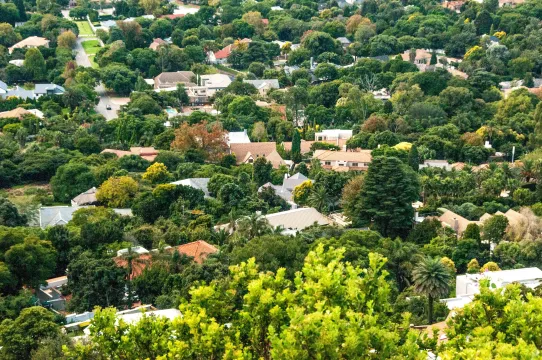
- The maps at the beginning of the reading do an excellent job of illustrating the relationship between tree cover and surface temperature.
Prerequisites
- Students should understand climate change and its impacts before reading.
- Students should know how to analyze maps.
Differentiation & Implementation
- To take a more inquiry-based approach, teachers can begin by having students analyze the images at the beginning of the article, without showing the heading above. Teachers can have students take note of what they notice and what they wonder about the connection between tree cover and surface temperature.
- Teachers can make connections to civics and history by taking time to discuss racism and historical redlining that lead to a disproportionate amount of people of color living in neighborhoods with less tree cover. This lesson does a great job of explaining this.
- Teachers can have students discuss how planting trees in neighborhoods with poor tree cover can help contribute to the Sustainable Development Goals, especially Goal 3, Good Health and Well-Being, and Goal 10, Reduced Inequalities.
- To deepen the connections to climate change, teachers can launch into a discussion about the increasing importance of cooling down neighborhoods in the face of climate change and how trees sequester carbon.
This resource is a concise introduction to the urban heat island effect. Sources are linked for all claims, with most being either from the EPA or peer-reviewed journals. The links between heat islands, tree cover, and climate change are all presented clearly through the text, interactive maps, and tables. This resource is recommended for teaching.
Teaching Tips
Standards
Resource Type and Format
Scientist Reviewed
This resource has been reviewed by SubjectToClimate's climate scientists and verified for scientific accuracy and up-to-date information. Our review process ensures that every resource in our library reflects the current state of climate science.
Learn about our review process →